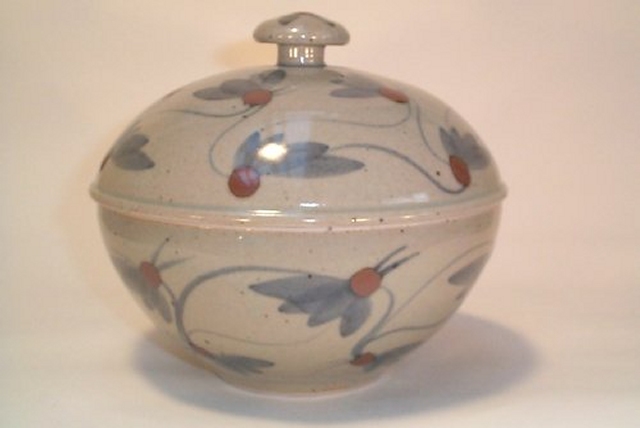
I have been a potter for just about all of my life. I started learning at school and self-taught to throw on the wheel. It has been a hobby ever since – although one that is often out of control. To support my self-learning I have been on courses in Denbigh and Brittany (where I met my wife who is also a potter). Over the years I have built several potteries and most of the equipment that goes in them.
I used to make thrown domestic stoneware fired to 1350’C in a gas-powered kiln - reducing hard from 1000’C onwards to get the copper reds and luscious celadons I was striving for. Making pottery has always been fun but I tired of the slog of trying to find outlets to sell the pots. Long days at craft fairs and struggling to cope with gallery markups slowed me right down and moved my wife more to teaching pottery than making it.
We live near Winchester and it was whilst attending a music concert at St Cross Hospice in the city that I first saw the medieval floor tiles. Ever since, whenever I visit a religious building, I am the one staring down at the floor whilst everyone else gazes heavenwards into the vaulted roofs.
When I started reading up about Medieval floor tiles I discovered they were at their zenith in the 12th to 13th century but all manufacture and use stopped with Henry VIII’s dissolution of the Monasteries in 1536. The monasteries were ransacked and pillaged during the resolution and few tile ‘pavements’ were left intact. With this came a loss of all the skills and expertise involved in making and laying the tiles and there are few artifacts or written records available to point us as how to make the tiles.
Floor tiling made a came back into fashion with the Gothic Revival in the 1840’s. However by this time England was far more industrialised and modern techniques such as plaster moulding and steam presses were used to make the more modern tile. The revival ran through to about the 1940’s and many churches, public buildings and houses (including my parent’s house) have some tiling from this period.
Interest in recreating medieval floor tiles started to develop in 1970’s. However after a long gap with no tile making the knowledge and expertise had disappeared and various potters have worked to recreate the skills and knowledge. They each developed their own methods and techniques to overcome problems common to any tile making. However, to my knowledge, there are very few written records of their methods. With several of the original potters retired or slowing down there is a risk that the skill set will again be lost. This blog is my attempt to counter this and lay down a (semi)-permanent record of what I have learnt and what I have done. The methods described may not be the original methods – some are too slow and, probably, to hampered by a fear of failure.
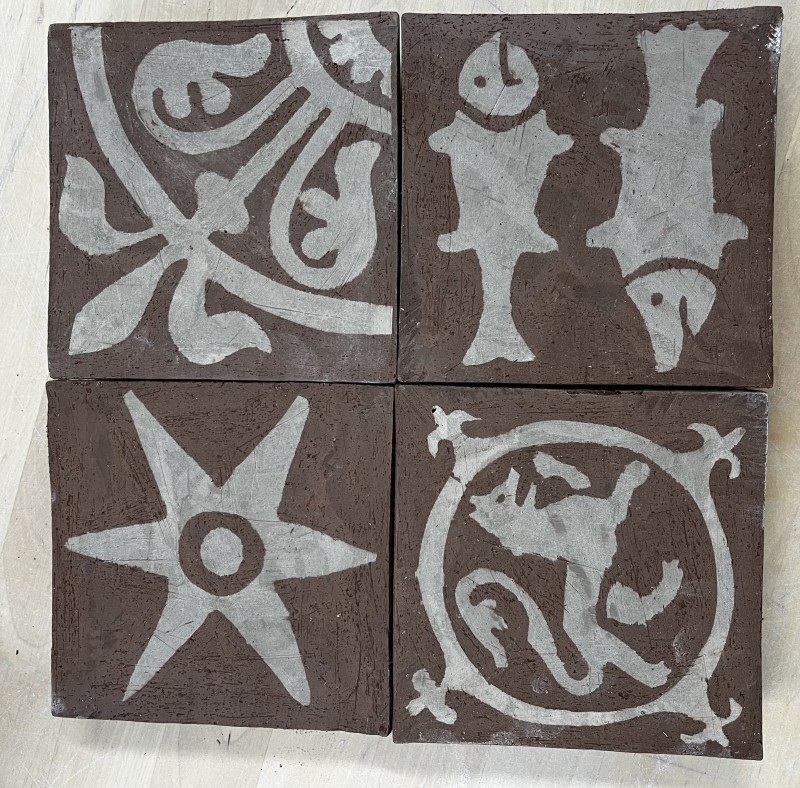
In the 12th century floor tile makers would have worked within a network the other crafts such as carpenters, lead workers, stone and wood carvers etc. that were needed to build the great buildings of that time. Working on my own I cannot hope to master all the different crafts that would have contributed to tile making. My ethos has been to start by learning to make the final product as authentically as possible and then with time to ‘work back’ to the supporting trades. To this end I use marine plywood and lino to make my ‘stamps’, I buy wood from the local DIY store for my moulds and I use modern sieves and surforms to work and shape the clay.