Medieval potters fired their tiles in simple, wood fired kilns. These have not survived well in the archaeological record so we have little detail. The kilns at Clarendon Palace and Norton Priory were simple chamber kilns over a split fire box. The roof lay on top of the wares so the roof and wares were set up when the kiln was loaded. Once loaded they were fired over several days.
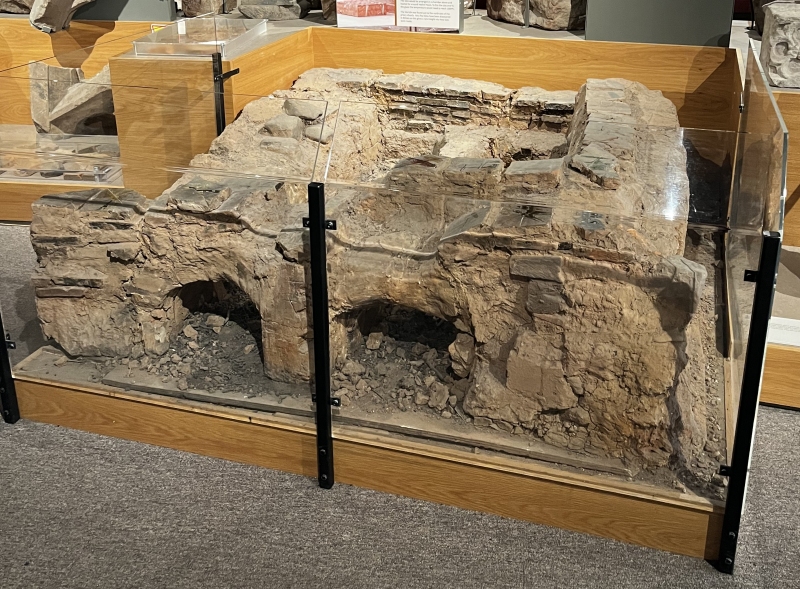
Norton Priory Museum at Runcorn has an extensive display and archive of how the mosaic tiles were made. Amongst this is the excavated remains of a tile kiln that looks very similar to others reported from Clarendon, etc by E. Eames. The kiln seems to be of a very simple ‘updraft’ design with two fire boxed at the bottom. The tiles were stacked (without kiln ware) and old tiles etc. placed on top as a temporary roof. I am not sure how much reduction could be achieved in this type of kiln - certainly modern replicate firings (Forrest Stevens, USA) do not show much signs of a reduction firing.
My Practice
I bought a very old, very cheap, small electric kiln second hand from eBay - it had been used by a church youth group in London. It lacked a controller so I have build one using an Arduino micro-processor and a Solid State Relay that allows manual or automatic firing. The kiln shelves are about 40 cm diameter and I can get in four layers of kilns+shelves. The kiln fires over about 10 - 11 hours and then cools over night.
I do not pack the kiln very tight - mainly to avoid tiles tapping into each other during loading. This chips / flakes off the glaze and then the flakes need removing and the tile touching up. I load the kiln with freshly glazed tiles - so they contain some moisture. I then ‘smoke’ the kiln on a low power setting (15 - 20%) over several hours until it reaches 150 - 200’C. The kiln is then fired on the automatic setting to about 1030’C (Orton cone 05).
Kiln stacking
There is debate over how the kilns were loaded for firing. The medieval potters would have used little or no kiln ‘furniture’ as this is made of high fired clay that can be used repeatedly but it itself is fired to a much higher temperature. The options are that tiles could have been fired vertically or horizontally.
Forrest Stevens (lives in Idaho and posts on Facebook) has been working to determine how tiles may have been fired. This summer (2025) he made and fired over 200 tiles in a kiln that he had built to medieval designs and patterns. Tiles are fired on edge leaning against each other and with no glaze on the side wall.
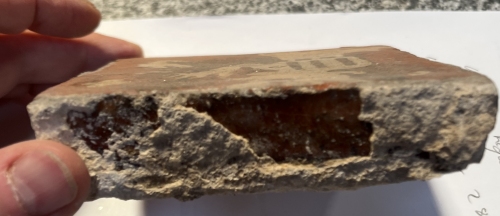
In the UK I have seen several tiles in collections with glazed side walls, so how were these fired? The (rather poor) picture below shows the side wall of a tile - this is glazed to the full depth which would have prevented vertical stacking (the tiles would stick to each other). It has been suggested these are fired flat and horizontal. This would then require some form of kiln furniture. To do this without the furniture sticking to the tiles would have been a real challenge.
Firing Mosaic tiles
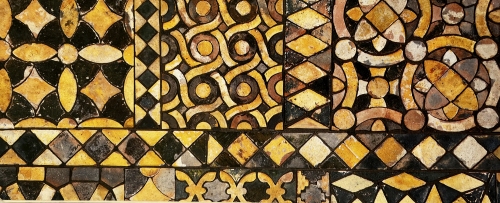
The Cistercian Abbeys in Yorkshire (Rievaulx, Fountains, Byland) have some beautiful examples of mosaic patterns. These probably pre-date the inlaid ‘Wessex’ style of tiles so the glazing and firing techniques would also be earlier. The image below shows some re-constructed tile patterns that are held at the British Museum. The use of different colours and the shapes of the individual tiles can be clearly seen. When one thinks about kiln stacking a vertical pattern seems very challenging and adds support to the idea of horizontal stacking [I am working to recreate the ‘swirly patter’, middle, top row - see a later post].
However if the tiles where stacked horizontally how were they stacked so they did not stick to each other? One can imagine small tetrahedral ‘stacking pieces’ placed between the tiles but these usually leave marks in the glaze.
Interestingly the tiles that Forrest Stevens fired show very little local reduction and colouring even though he used a wood fired kiln that burnt over several days. This suggests an ample airflow. Stacking tiles horizontally with a limited space between the layers would limit airflows and increase the chance of getting a reducing atmosphere.